

Technological Success with the Installation of the First Reference Altimetric Stations on the Antarctic Ice Sheet for ESA’s St3TART-FO Project
The Institute of Environmental Geosciences (IGE) has achieved a key milestone in the St3TART-FO project by deploying the first reference altimetric measurement stations on the Antarctic ice sheet.
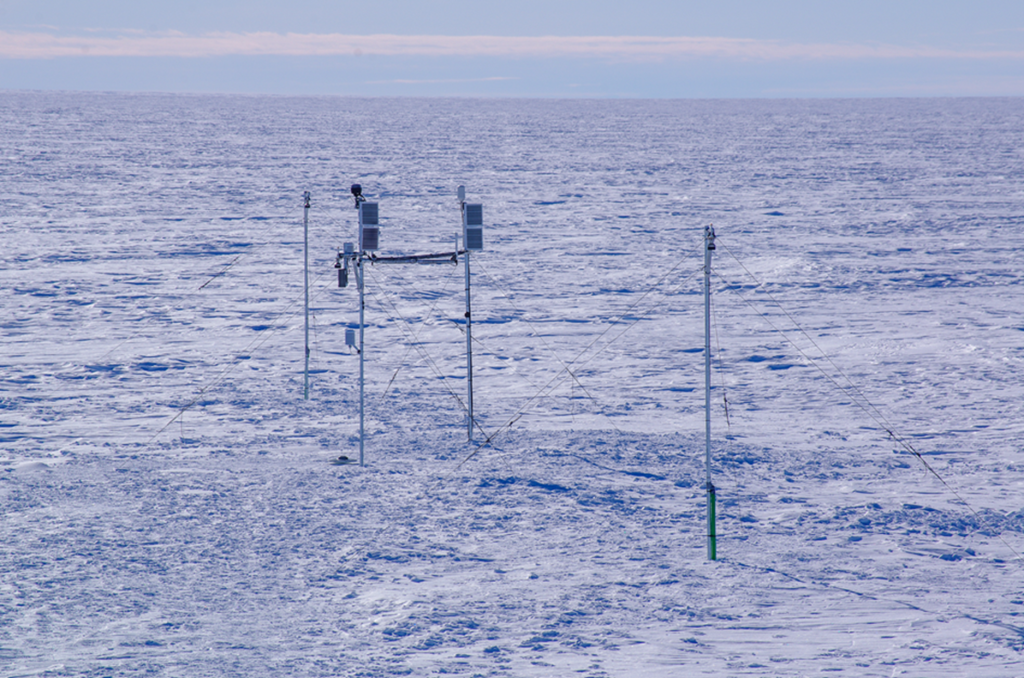
As part of the St3TART-FO project (https://sentinel3-st3tart.noveltis.fr/), led by NOVELTIS, funded by the European Space Agency (ESA) and European Commission as part of the Copernicus Programme, the Institute of Environmental Geosciences (IGE), with logistical support from the French Polar Institute Paul-Émile Victor (IPEV), has successfully installed the first two absolute altitude measurement stations in Antarctica. These stations (Figure 1), named premisses 01 and premisses 02, aim to provide high-precision in-situ measurements (known as Fiducial Reference Measurements, or FRM). These measurements are essential for calibrating and validating radar altimetry data from the Sentinel-3A and Sentinel-3B satellites of the Copernicus Programme, with an accuracy of just a few centimeters.
An Ambitious Technical and Logistical Challenge
After a year of preparation and testing in the Alps, and a complex logistics operation to transport the equipment, the two stations were finally installed by Emmanuel Le Meur and Arnaud Reboud, members of the field team. These stations, equipped with multiple ultrasonic sensors to accurately assess snow height and with GNSS (Global Navigation Satellite System) to precisely position the station subject to ice flow and deformation, have been deployed at the following coordinate points:
- premisses 01: 137.822°E / 67.719°S
- premisses 02: 138.745°E / 66.954°S
The installation was carried out during a scientific expedition that took place from December 25, 2025, to January 15, 2026, under harsh weather conditions. Significant logistical resources were required to protect against katabatic winds, known for their extreme intensity.
Beyond installing the sensors, the project also included drone flights around the stations. This had never been achieved before in this area, where climatic conditions and proximity to the magnetic pole make navigation particularly complex. Despite these challenges, a favorable weather window allowed the acquisition of crucial topographic data, essential for creating digital surface models (DSMs). These DSMs were generated using two methods: photogrammetry and airborne LiDAR measurements.
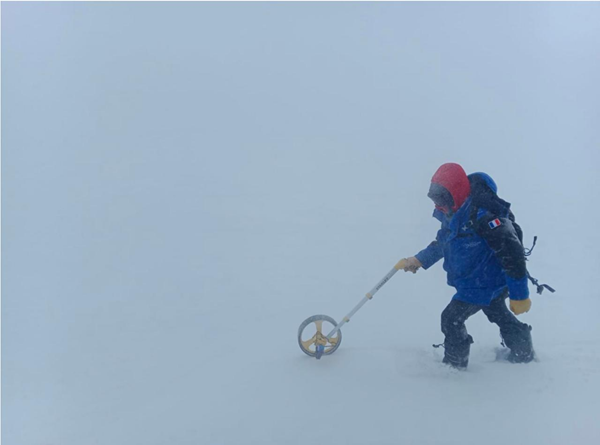
Additionally, the team successfully collected an independent validation dataset using a topographic wheel, even under severe blizzard conditions (Figure 2). Together, these data will enable spatial extrapolation of the ground-based altitude measurements provided by the stations.
Promising Results
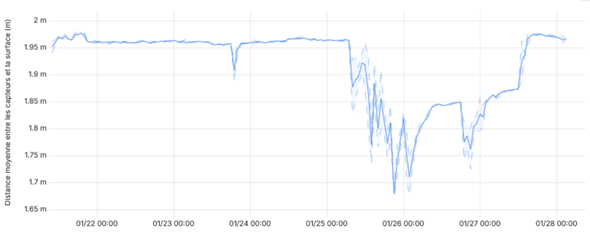
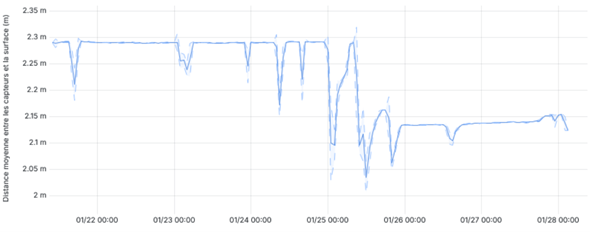
The stations are now operational and transmitting all collected data. This data is processed through a dedicated processing chain and will soon be available in real-time online (Figure 3). The IGE team involved in this project is currently analyzing the on-site data and estimating the final accuracy of the data. Their goal is to produce distributed altimetric data, which will validate the radar altimetry measurements taken along the orbits of the Sentinel-3A and Sentinel-3B satellites.
Preliminary results are highly encouraging, with vertical accuracy meeting the specifications initially proposed to qualify the measurements as Fiducial Reference Measurements (FRM).
An International Collaboration for Science
This mission highlights the success of international collaboration within the St3TART-FO project, led by NOVELTIS and funded by the European Space Agency (ESA) and European Commission as part of the Copernicus Programme. In the field, IGE relied on the commitment of the teams from the French Polar Institute Paul-Émile Victor (IPEV).
The data collected by the St3TART-FO project stations will help improve the accuracy of satellite measurements, which are essential for monitoring the mass loss of the ice sheet, a critical factor influencing sea-level rise in the coming decades.
According to climate and ice-sheet flow models, the melting of the Antarctic ice sheet could contribute to a sea-level rise of approximately 30 cm by 2100.