

2025 marked a highly successful first operational year for the St3TART-FO project’s sea ice activities, with a strong focus on Svalbard.
One of the main objectives of the St3TART-FO project (https://sentinel3-st3tart.noveltis.fr/), led by NOVELTIS and funded by the European Space Agency (ESA) and European Commission as part of the Copernicus Programme, is to identify and operate super and opportunity sites for Cal/Val activities over sea ice, but also land ice, and inland water domains.
The region of Svalbard was previously identified within the St3TART project as a key location and a strong candidate for a Sentinel‑3 Calibration and Validation (Cal/Val) supersite, due to its excellent accessibility and relevance for high‑latitude Earth observation.
Located in the high Arctic and fully covered by Sentinel‑3, Svalbard lies close to the satellite’s orbit turn-around latitude, resulting in a high density of satellite overpasses. The presence of landfast first-year ice in the fjords provides a controlled environment for experiments on sea ice thickness and snow cover. At the same time, nearby drifting sea ice in areas such as Storfjorden allows the observation of seasonal transitions and variability across spatial and temporal scales. This unique combination makes Svalbard an exceptional natural laboratory for advancing our understanding of sea ice evolution under changing climatic conditions.
The presence of glaciers and polar ice caps also makes it possible to combine measurements, such as airborne or drone measurements, for different types of surfaces of interest in polar regions.
All activities were carefully designed to deliver Fiducial Reference Measurements (FRMs) for Sentinel‑3 sea ice validation, following established best practices and international Cal/Val standards.
Key activities during the first operational year included:
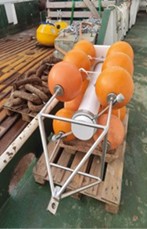
- Deployment of an Ice Profiling Sonar (IPS) mooring (Figure 1, left panel) in Storfjorden at a Sentinel‑3B and ICESat‑2 crossover location, as part of the St3TART‑FO baseline activities, enabling continuous monitoring of sea ice draft and oceanographic conditions.
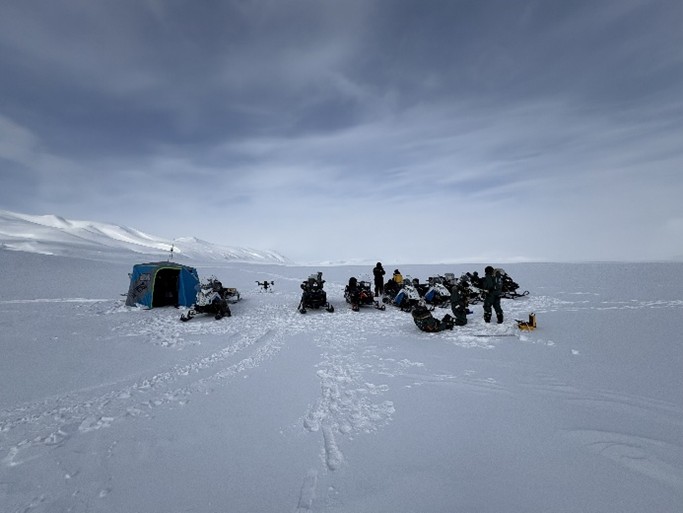
- A drone campaign (Figure 1, right panel) combining snow radar and lidar, supported by complementary ground-based measurements of snow depth and properties along a dedicated Sentinel‑3 ground track in Storfjorden, operating from Agardhbukta.
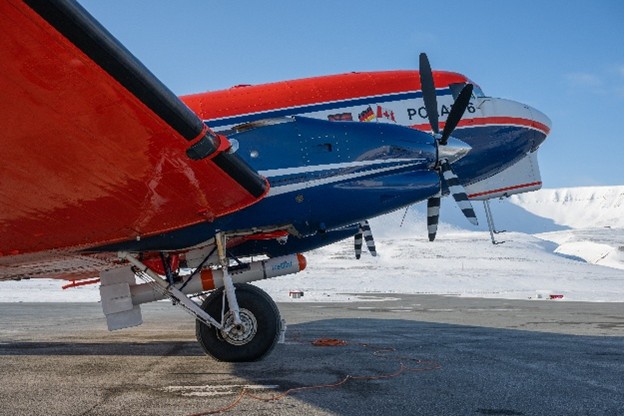
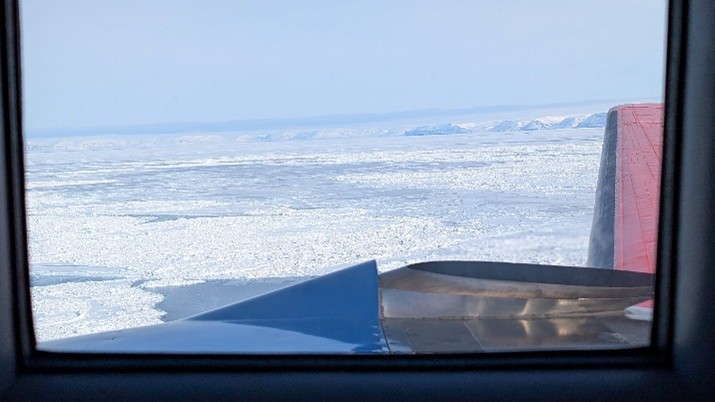
- Near‑coincident airborne measurements (Figure 2) with drone along Sentinel-3 master-track and extended 200 km beyond using the AWI IceBird Polar‑5 aircraft, equipped with a snow radar for snow depth retrievals, an electromagnetic (EM) sensor for sea ice thickness, and a laser scanner for snow freeboard measurements. Additional 1,200 km dedicated Sentinel-3 under-flights were acquired in the Beaufort Sea.
- Deployment of an Ice‑T drifting buoy at the magnetic North Pole to measure sea ice thickness and snow depth.
The project team is currently analysing the coordinated ground-based, drone, airborne, and Sentinel‑3 observations over sea ice with complex snow conditions, enabling cross-scale comparisons and improved satellite validation. Preparations are underway for follow-up field activities in spring 2026, which will include repeat measurements to assess seasonal evolution.
The campaign was supported by the University Centre in Svalbard (UNIS) in Longyearbyen, UiT – The Arctic University of Norway in Tromsø through ship time aboard the R/V Helmer Hansen during a student cruise, as well as during an Arctic expedition aboard Le Commandant‑Charcot operated by Ponant.